


The Emirates ID in Dubai is the official UAE identity card for citizens and residents. It is issued by the Federal Authority for Identity, Citizenship, Customs and Port Security, known as ICP, and is mandatory for UAE citizens and UAE residents.
- Every UAE resident needs an Emirates ID, including employees, investors, dependants, domestic workers and free zone visa holders.
- The core ICP fee for residents is 100 per year of residence validity, plus an 100 smart service fee.
- Applicants aged 15 and above complete fingerprint and signature registration through ICP service centres.
- The standard ICP service duration is five days once the identity card application requirements are complete.
- The card is used for UAE PASS, banking KYC, telecoms, Ejari, utilities, tax registration and beneficial ownership records.
What the Emirates ID Is Used For in Dubai
The Emirates ID is the UAE Government-issued identity card for UAE citizens and residents. It is used for government services, identity verification and private sector processes connected to residency, banking, telecoms, property administration and company compliance.
The UAE identity system was created under Federal Law No. 2 of 2004, which established the Population Register and Emirates Identity Card Programme. The card carries a unique identity number, readable personal data and data stored on an electronic chip.
ICP is the current federal authority responsible for Emirates ID services. Older references to EIDA, ICA or FAIC may still appear in legacy material, but ICP is the correct authority name for current identity services.
What’s the Difference Between an Emirates ID and a Residence Visa?
The Emirates ID is not the same document as a residence visa. A residence visa gives an expatriate the legal right to live in the UAE.
The Emirates ID proves the person’s identity as a UAE resident and links that identity to UAE digital and administrative systems. A founder can form a UAE company before becoming resident, but once they apply for a UAE residence visa, the Emirates ID becomes part of the resident onboarding process.
Who Needs an Emirates ID in Dubai?
Every UAE citizen and UAE resident must hold an Emirates ID. This includes children and newborn babies, as well as expatriate residents sponsored by employers, companies, family members, domestic worker sponsors or long-term residence routes.
For expatriates, the rule applies across residence categories, including employees, investors, company partners, dependants, domestic workers, Golden Visa holders, Green Visa holders, eligible freelancers, remote workers and free zone visa holders.
Tourists and visit visa holders do not apply for an Emirates ID unless they later move into a qualifying UAE residence category.
Emirates ID for Free Zone Visa Holders and Non-Resident Shareholders
Free zone status does not remove the Emirates ID requirement. A free zone company may sponsor or coordinate the residence route, but the identity card remains an ICP service.
A non-resident shareholder is different. A person can own shares in a UAE company without holding UAE residence. In that case, an Emirates ID is not required solely because the person is a shareholder. Passport-based identification is used until the person applies for and obtains UAE residence.
Founders planning free zone company setup should decide early whether they need a visa quota, because residence processing affects Emirates ID timing, banking preparation and UAE PASS access.
How to Get an Emirates ID in Dubai
For expatriates, the Emirates ID application in Dubai is part of the wider UAE residence process. Dubai residence procedures run through GDRFA Dubai and AMER channels, while ICP issues the identity card.
The process usually follows this order:
1. Choose the Right Residence Route
Common routes include employment, investor, partner, dependant, Golden Visa, Green Visa and virtual work residence. The route affects the sponsor, documents, residence validity and card validity.
2. Complete Status Amendment if Needed
Applicants already in the UAE on a different status may need to amend their status before residence processing continues. This is common when a founder enters on a visit visa and then moves onto a company-linked residence route.
3. Complete the Medical Fitness Test
Residence applicants aged 18 and above must complete medical fitness screening before final residence approval and card completion.
4. Submit the Application
The application can be submitted through ICP Smart Services, the ICP Smart App, an ICP customer happiness centre or an approved typing centre. Dubai applicants should treat the residence file and identity card file as connected, but not identical.
5. Attend Biometrics
Applicants aged 15 and above complete fingerprint and signature procedures through ICP service centres. Missed biometrics or unresolved application corrections can delay issuance.
Through DUQE’s value-added services, founders and visa holders can have the Emirates ID process handled from start to finish, including medical fitness coordination, Emirates ID typing, document preparation and application follow-up. ICP remains the issuing authority, while DUQE helps keep each step properly sequenced during the wider residence visa process.
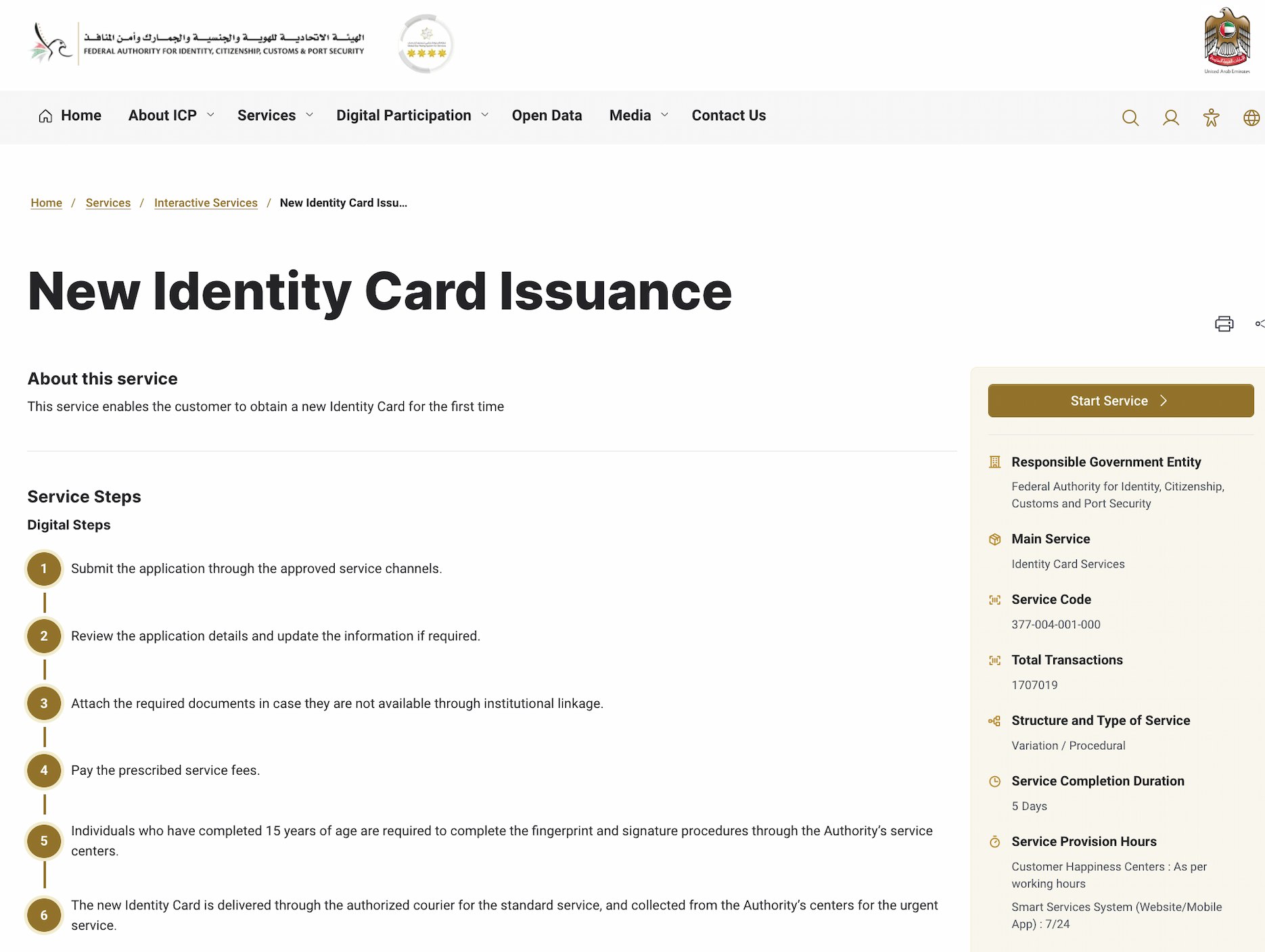
Emirates ID Documents Required in Dubai
The exact document set required depends on the residence route, sponsor and applicant category. Most expatriate applicants should prepare a valid passport, passport-standard photograph, residence application details, medical fitness result where applicable, and sponsor or employer details.
Employees usually require passport details, photograph, residence application details and employer-linked sponsorship documents.
Founders and investors may also need the trade licence, ownership documents, appointment documents and immigration establishment records connected to the sponsoring company or free zone entity.
Dependants may need relationship evidence, such as a marriage certificate or birth certificate.
Domestic workers follow the domestic worker residence route, with the sponsoring employer managing the residence and identity sequence.
DUQE can help founders align the residence route with business setup in Dubai, licence selection and visa planning before the Emirates ID application begins.
Emirates ID Cost in Dubai
For expatriate residents, the core ICP fee for a new Emirates ID is 100 for each year of residence validity, plus an 100 smart service fee. Renewal uses the same 100 per year structure, plus an 100 smart application fee.
Based on that ICP fee structure, excluding assisted service charges and any separate visa-side costs:
- A one-year resident card calculates as 200
- A two-year resident card calculates as 300
- A three-year resident card calculates as 400
- A ten-year resident card calculates as 1,100
For lost or damaged cards, replacement is 300, plus an 100 smart service fee. Urgent service, where available through an ICP service centre, carries an additional 150 fee.
Emirates ID Timeline in Dubai
The standard ICP service duration for new Emirates ID issuance is five days once the identity card application requirements are complete. For a new Dubai resident, the full timeline is longer because the wider residence process may include entry permit issuance, status amendment, medical fitness, residence processing, biometrics, ICP approval and delivery.
Preventable delays include an incomplete sponsor file, expired passport, non-compliant photograph, pending medical fitness result, missed biometrics, inconsistent personal details or inaccurate delivery information.
Managing Your Emirates ID after You Apply
After the Emirates ID application is submitted, residents usually need to check status, track delivery, update linked records or confirm whether fines apply. These checks are especially important for founders who need the card for UAE PASS, banking, telecoms, insurance or company administration.
How Do You Check Emirates ID Status Online?
You can check your Emirates ID status online through ICP using the application number, also called the PRAN, or the Emirates ID number for renewal and replacement applications.
For a first Emirates ID application, the PRAN is usually the most useful reference because the physical card has not yet been issued. For renewal or replacement, the Emirates ID number can be used to check the application status.
Can You Check Emirates ID Status with a Passport Number?
ICP’s Emirates ID status service does not use the passport number as the main reference for card tracking. Use the PRAN, Emirates ID number or request number instead.
If you only have your passport number, check the application receipt, ask the sponsor or service centre for the PRAN, or follow up with the party that submitted the residence and Emirates ID application.
How Do You Track Emirates ID Delivery?
Once ICP has processed the card, delivery follows the approved channel shown in the application or service notification. If the status shows that the card has been issued but it has not arrived, check the mobile number, delivery address and recipient details linked to the application.
If the application was submitted through an employer, free zone, Amer centre or business setup adviser, that party should also check whether the delivery details were entered correctly.
Can You Download Emirates ID Online?
Residents can access digital identity documents through the ICP UAE Smart app where available. The app includes a digital wallet for personal documents, including digital identities and residencies.
A digital version can help with some checks, but it should not be treated as a full substitute for the physical card in every banking, telecom, government or legal process.
Can You Add Emirates ID to Apple Wallet?
The most reliable way to access a digital Emirates ID is through the ICP UAE Smart app, which includes a digital wallet for official personal documents. Apple users may see an option to add the card to Apple Wallet inside the official app, but this depends on the app version, device and account eligibility.
If the Apple Wallet option does not appear, use the ICP UAE Smart app instead. A digital copy can help with some online checks, but it should not be treated as a full replacement for the physical card. Banks, telecom providers, government counters and legal processes can still ask to see the original Emirates ID.
How Do You Check Fines on Emirates ID?
If your card has expired, check whether a late renewal fine applies. The fine is 20 per day after 30 days from expiry, capped at 1,000.
For public transport, traffic or immigration fines linked to your identity record, use the service run by the authority that issued the fine. For example, eligible Dubai public transport fines can be checked through Dubai’s Roads and Transport Authority, RTA. These fines are not checked through the Emirates ID application status page.
Can You Check RTA Bus Fines with Emirates ID?
Dubai public transport passenger fines can be searched through RTA using the fine number, Emirates ID or passport number. Vehicle and bus lane fines use different references, such as fine number, plate details, licence number or traffic file number.
A metro, tram, bus or marine transport passenger fine is not the same as a vehicle-related traffic fine, so the correct RTA service depends on the fine type.
How Do You Change the Mobile Number Linked to Emirates ID?
Mobile number and address updates are handled through ICP’s data update service. This service updates non-essential data in the ICP system.
If the phone number is also linked to UAE PASS, telecom accounts, banking or tax platforms, those records may need to be updated separately. Updating ICP records does not automatically update every private service provider.
How Do You Update Emirates ID in Etisalat, du and UAE PASS?
After your Emirates ID is renewed or replaced, update your details directly with your telecom provider. For e& (Etisalat) or du, this is usually done through the provider’s app, website, store or customer support channel. Keep the physical card or official digital ID available, as the provider may need to verify the renewed details before keeping the mobile line active.
UAE PASS should be checked separately. If your mobile number, Emirates ID details or residence record has changed, update the relevant ICP and UAE PASS records before using UAE PASS for banking, tax registration, licence services or document signing.
Updating one record does not automatically update every other system. Your telecom account, ICP record, UAE PASS profile, bank and tax portal may each need to reflect the current details.
Can You Check Medical Insurance with Emirates ID?
Healthcare providers and insurers often use Emirates ID to identify the insured person and verify medical records or cover. For Dubai residents, insurance status should be checked through the insurer, healthcare provider or relevant Dubai health platform.
The Emirates ID confirms identity. It does not replace the insurer’s policy status, network approval or claims process.
Is the UID Number the Same as Emirates ID?
No. The UID number and Emirates ID number are different identifiers.
The Emirates ID number is the identity number printed on the Emirates ID card. The UID, or unified number, is connected to immigration and residence records. Both can appear during the visa and residence process, but they should not be treated as the same number.
Urgent Emirates ID Service for Expatriate Residents
Urgent Emirates ID service is narrower for expatriate residents than for UAE nationals and GCC nationals. UAE nationals and GCC nationals residing in the UAE can use the 24-hour service for first-time registration, renewal and replacement.
Expatriate residents other than GCC nationals can use urgent service only for replacement of identity cards. For most expatriate founders and employees applying for a first Emirates ID, urgent issuance is not available. The priority is accurate document preparation, completed medical fitness, timely biometrics and correct delivery details.
Emirates ID Renewal in Dubai
Emirates ID renewal can begin after expiry or when less than six months remain before expiry. If the passport has expired, renew the passport before applying for Emirates ID renewal.
Applicants aged 15 and above complete fingerprint and signature procedures again where ICP requires them. The late renewal fine is 20 per day after one month from expiry, capped at 1,000.
Service issues can begin earlier if a bank, telecom provider, UAE PASS flow, Ejari process, utility provider or tax portal requires valid identity details. Card holders must carry the Emirates ID, produce it when legally required, follow renewal and replacement procedures, report changes to card details within one month and report loss within seven days.
The card must not be left with an organisation unless there is a competent court decision or judgment.
Where Residents Use the Emirates ID in Dubai
The Emirates ID is the main resident identity document for many public and private sector services. It is used across digital identity, telecoms, banking, property, utilities and healthcare administration.
UAE PASS
UAE citizens and residents use a valid Emirates ID and active UAE mobile number to create and verify a UAE PASS account. UAE PASS gives access to government, semi-government and private sector services.
Telecoms
SIM registration uses the original Emirates ID. Copies or scanned images are not accepted. This makes mobile number planning important because UAE PASS, banking and government portals often depend on a UAE mobile number.
Banking
Emirates ID verification forms a central part of resident KYC. Licensed financial institutions verify Emirates ID cards through official validation channels and may still request passport, visa details, proof of address, funds-origin evidence and company documents.
Ejari and Utilities
Emirates ID supports tenant identity checks in Dubai. For standard tenancies, Ejari, Dubai’s tenancy registration system, is linked to move-in services with Dubai Electricity and Water Authority, DEWA. Selected free zone premises may follow a separate DEWA digital application route.
Travel and Government Services
The Emirates ID is used for government services, Federal National Council voting where applicable, and smart gates at several UAE airports. UAE citizens may also use it for travel within GCC countries. Expatriate residents should use their passport and check the entry rules for the country they are visiting.
Emirates ID for Children, Domestic Workers and Long-Term Visa Holders
Children registered as UAE residents must have an identity card. Applicants under 15 do not complete the adult fingerprint and signature procedure, as biometric registration starts from age 15.
Domestic workers are also covered once they hold UAE residence. Their application follows the relevant domestic worker residence route, with the sponsor managing the visa and identity card sequence.
For long-term residents, the identity card validity follows the approved residence period. A Golden Visa can be issued for five or ten years, depending on the applicant’s category, so the card is issued in line with that longer residence term. Green Visa holders also receive a multi-year residence route, covering eligible skilled workers, freelancers, self-employed persons, investors and business partners.
Emirates ID and Company Compliance for Founders
For resident founders, the identity card is part of the company’s practical compliance file. It is often needed for corporate bank account opening, tax registration, authorised signatory records and beneficial ownership documentation.
For corporate tax and VAT registration through EmaraTax, resident owners and authorised signatories should be ready to provide identity and passport documents. The Emirates ID number is separate from the Tax Registration Number, TRN, which is issued by the Federal Tax Authority for tax purposes.
Beneficial ownership records also rely on accurate identity details. For UAE-resident beneficial owners, the card can support the company’s record of identity card number, issue date and expiry date. Non-resident shareholders generally provide passport and overseas identity documents instead.
Banks may also request the card for UAE-resident shareholders, managers, directors and authorised signatories during corporate account opening. Requirements vary by bank, business activity, ownership structure and risk review.
How DUQE Supports Medical Fitness and Emirates ID Typing
For many founders, the slowest part of the residence process is not the Emirates ID application itself. It is coordinating the medical fitness test, Emirates ID typing, document checks and follow-up steps in the correct order.
DUQE supports this stage by helping founders and visa holders handle medical fitness testing and Emirates ID typing as part of the wider residence visa process. This is useful for free zone company owners, employees and dependants who want the required steps managed through one coordinated setup route.
ICP remains the authority that issues the Emirates ID, and the relevant UAE authorities make the final checks. DUQE’s role is to help prepare the file, coordinate the process and reduce avoidable delays caused by missing documents, incorrect sequencing or incomplete application details.

Plan Your Emirates ID with DUQE
For Dubai residents and founders, the Emirates ID is central to the residence process. It supports UAE PASS, mobile registration, banking, Ejari, utilities, tax registration and everyday identity checks across the UAE.
Through our value-added services, we can handle your Emirates ID process from start to finish, including medical fitness coordination, Emirates ID typing, document preparation and application follow-up. We keep each step in the right order, helping reduce delays during residence visa processing and business setup.
Need help securing your Emirates ID? Contact us and we’ll guide the process from application preparation to completion.
Emirates ID FAQs
Is Emirates ID Mandatory in Dubai?
Yes. Every UAE citizen and UAE resident must hold an Emirates ID, including expatriate residents in Dubai.
Can I Get Emirates ID without a Residence Visa?
Expatriates need a qualifying UAE residence process. Tourists and visit visa holders do not apply for Emirates ID unless they move into residence status.
Do Free Zone Visa Holders Need Emirates ID?
Yes. A free zone visa holder is a UAE resident, so the Emirates ID requirement applies.
How Much Does Emirates ID Cost in Dubai?
For expatriate residents, the ICP fee is 100 for each year of residence validity, plus an 100 smart service fee for new issuance or an 100 smart application fee for renewal.
How Long Does Emirates ID Take after Biometrics?
ICP lists five days as the identity card service duration once the application requirements are complete. The full resident timeline depends on residence approval, medical fitness, biometrics and delivery.
How Do I Check My Emirates ID Status?
You can check Emirates ID status through ICP using the application number, also called the PRAN, or the Emirates ID number for renewal and replacement applications.
How Do I Track My Emirates ID Delivery?
Track the application through ICP using the PRAN or Emirates ID number. If the card has been issued but not received, check the delivery details with the sponsor, service centre or submitting party.
How Do I Check Fines on Emirates ID?
For late Emirates ID renewal, the fine is 20 per day after 30 days from expiry, capped at 1,000. For transport, traffic or immigration fines, use the authority that issued the fine.
Can I Open a Bank Account without Emirates ID?
A UAE resident will usually need Emirates ID for bank KYC. Non-resident account options depend on the bank, customer profile, documents, activity and risk review.
Is Emirates ID the Same as UAE PASS?
No. Emirates ID is the physical and smart identity card. UAE PASS is the national digital identity used to access and sign into digital services.
What Happens if I Do Not Renew My Emirates ID?
A late renewal fine of 20 per day applies after one month from expiry, capped at 1,000. Expiry can also affect banking, telecoms, UAE PASS, Ejari, utilities and tax portal access.